Print Language & Variants Matter for Price: Why Collector Details Count
A German Reverse Holo and an English Base card of the same card are two distinct products on Cardmarket with completely different price curves. Generic trackers lump variants together, distorting your portfolio value. LootLink tracks every variant and print language separately.
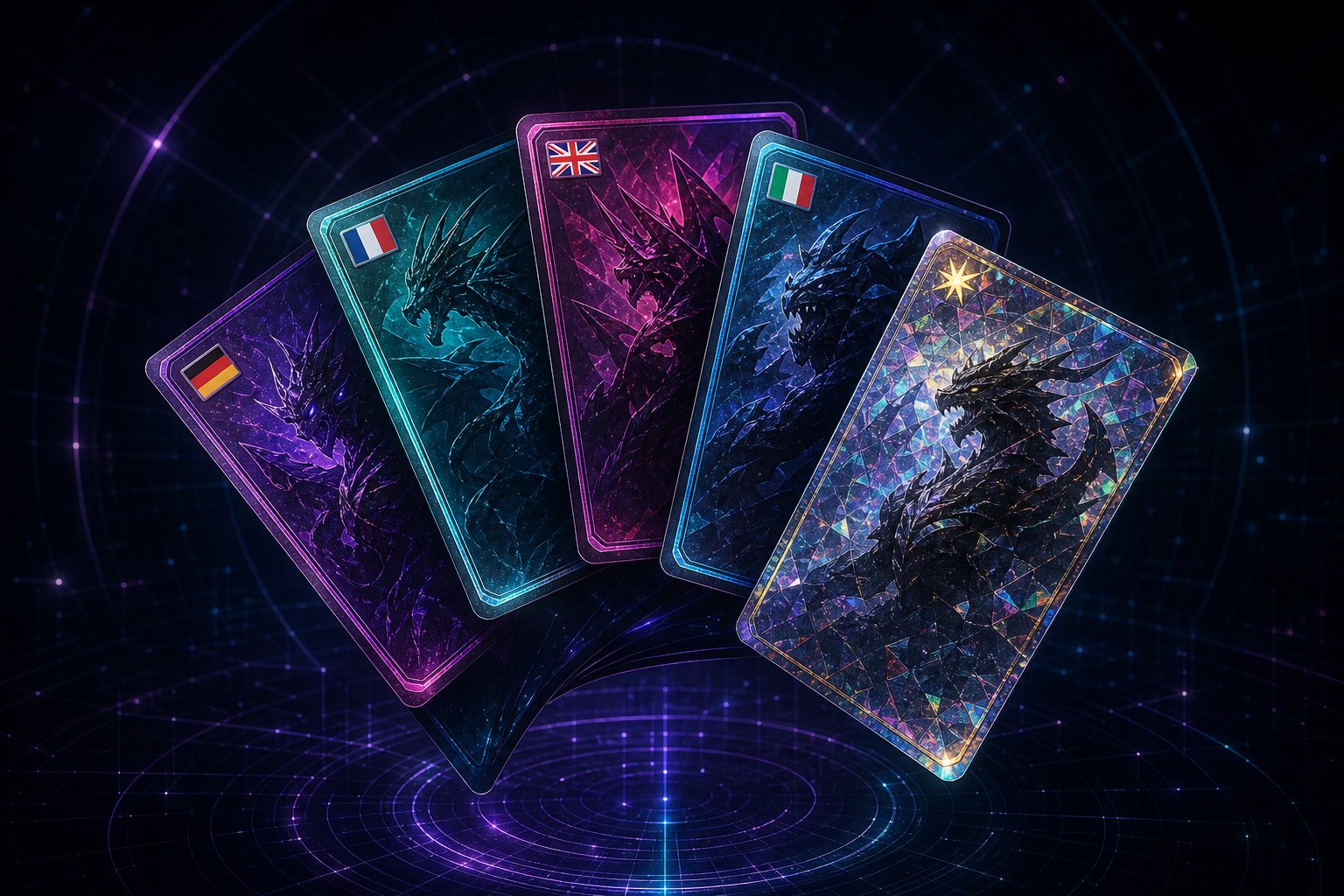
Why a German Reverse Holo Is Not an English Base Card
In the trading card market, subtle details dictate rarity and value. Consider a concrete example: A popular card like Umbreon (Nachtara) from a modern expansion exists in multiple print languages and foil finishes. A German Reverse Holo, featuring a matte image window with a holographic pattern across the text box, has distinct supply and demand dynamics on Cardmarket.
An English base non-holo version of the exact same set number is an entirely different product. English printings often have much higher global print runs, whereas German or French Reverse Holos enjoy intense localized demand from regional completionist collectors. When an application merges these variants into a single entry and displays a blended average price, the resulting valuation is completely inaccurate.
Comprehensive Classification of Card Variants
To deliver true portfolio accuracy, collection software must distinguish between all official card finishes and print runs. LootLink categorizes every card according to its precise physical specifications:
- Standard / Non-Holo: The classic non-foil printing.
- Holo / Holographic: Reflective foil pattern restricted to the artwork window.
- Reverse Holo: Foil pattern covering the entire card frame while the artwork remains matte.
- Pokéball & Masterball Holo: Distinctive foil impressions featured in Japanese and special international expansions with massive price premiums (a Masterball Holo parallel can be worth 50x the base non-holo card).
- Promo Prints & Stamped Variants: Cards distributed at prerelease tournaments, retail events, or championships featuring custom stamped logos.
- First Edition (1st Edition): Historic initial print runs bearing official first edition stamps.
The Impact of Foil Finishes on Market Liquidity & Player Demand
Physical card finishes appeal to distinct segments of the trading card community. Competitive tournament players often seek affordable non-holo playsets for their deck builds, while completionist collectors compete for rare parallel foil finishes.
These distinct buyer groups drive completely decoupled market dynamics. When a new tournament strategy emerges, demand for the base non-holo card spikes rapidly while the high-end foil parallel remains stable. LootLink accurately captures these independent market movements by evaluating each finish separately every single day.
Transparency Across Modern Rarity Tiers & Special Editions
Beyond traditional foil parallels, modern expansions introduce intricate rarity structures: Secret Rares, Alternate Art printings, Illustration Rares, and Gold Special editions. Each of these categories follows distinct pricing trajectories. While standard set cards may depreciate over time, desirable Illustration Rares frequently experience exponential appreciation. Grouping these distinct tiers under a generic label obscures true portfolio trajectory. LootLink ensures every rarity tier and special printing holds its exact placement in your digital catalog.
Regional Set Completion & Completionist Collector Behavior
European markets feature a strong culture of "Master Set" collecting – the endeavor of collecting every card within an expansion, including all Holo and Reverse Holo parallels in the collector's native language. A German collector completing a German Master Set requires specifically the German Reverse Holo variant.
When collection trackers ignore regional nuances, major valuation errors occur. A rare Masterball Holo card gets valued down to a 50-cent base card, understating portfolio value by hundreds of euros. LootLink protects collectors from these distortions through disciplined catalog disaggregation.
Catalog Disaggregation for Exact Portfolio Truth
Generic tracking tools frequently flatten variant options to reduce database complexity. However, this shortcut harms serious collectors: Rare parallel foil variants get undervalued down to base prices, while common cards get inflated by high-end listings. Your portfolio calculation fails at every level.
LootLink enforces strict catalog disaggregation. Every combination of card, print language, and variant finish holds its own dedicated database record linked to corresponding Cardmarket market feeds. When you scan a German Reverse Holo, it is cataloged specifically as such and paired with active Cardmarket trend prices for German Reverse Holos.
Frictionless Trades Through Accurate Catalog Mapping
Precision prevents disputes during trade negotiations. When you show your digital trade binder to another collector, they see the exact finish, language, and market reference for every single card. There is zero ambiguity regarding what is being offered.
By enforcing disciplined separation across languages and variants, LootLink guarantees that your digital portfolio mirrors your physical binder down to the smallest detail.
Every Variant Deserves Its Own Line Item
Eliminate inaccurate price averages. LootLink tracks every print language, foil variant, and promo edition separately, linking each directly to real Cardmarket valuation data.
Follow us on Threads or Instagram – we post go-live updates and launch news there.
Why do many other apps display the same price for Holos and Reverse Holos?
Many international apps simplify their database structure by grouping variants together and displaying only the base card price. LootLink categorizes Standard, Holo, Reverse Holo, and Promo variants separately, assigning authentic Cardmarket price points to each specific finish.
Which print languages are supported by LootLink and how are they identified?
LootLink supports all major European and international TCG print languages (German, English, French, Spanish, Italian, Japanese, etc.). Our local camera analysis module detects the print language automatically from text features during the scan process.